Nathan Tischler Published in CanLII Connects

On October 3rd, 2021, CanLII (the Canadian Legal Information Institute) published the following article in their CanLII Connects Commentaries:
Read More about Nathan Tischler Published in CanLII Connects

On October 3rd, 2021, CanLII (the Canadian Legal Information Institute) published the following article in their CanLII Connects Commentaries:
Read More about Nathan Tischler Published in CanLII Connects
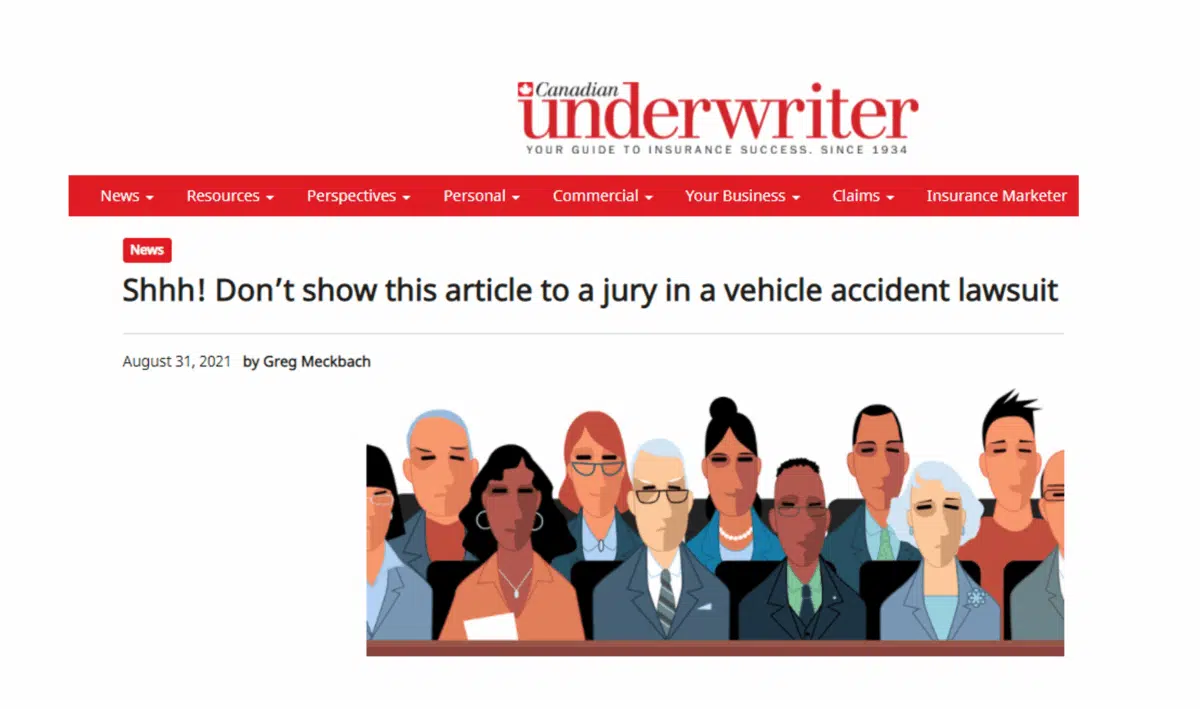
In the August 31st, 2021 article, “Shhh! Don’t show this article to a jury in a vehicle accident lawsuit“, insurance industry magazine Canadian Underwriter cites the expert opinion of Campisi lawyer Nathan Tischler in a story about motor vehicle accident tort claims. In the context of a recent lawsuit, writer Greg Meckbach highlights this fact to which jury members are often oblivious: that a statutory deductible of almost $40,000 exists for pain and suffering in these cases.
Read More about Campisi’s Nathan Tischler Quoted in Canadian Underwriter Magazine
Congratulations to our own Joseph Campisi who has been recognized in the 2022 edition* of Best Lawyers® in Canada for Personal Injury Litigation. Based on the principle that “the best lawyers know who the best lawyers are”, professionals who are included in this prestigious listing are selected entirely based on peer review.
Read More about Joseph Campisi Recognized by Best Lawyers® in Canada
Congratulations to Campisi’s own Tracy Romanowski for being awarded the John A. McLeish Award for 2020!
Read More about Tracy Romanowski Awarded 2020 John McLeish Award by the OTLA
The COVID-19 pandemic has not only made our justice system inaccessible for many but has placed an exceptional burden on disabled persons with personal injury claims.
Following the onset of the pandemic, the Ontario government suspended most court activities, including all civil lawsuits. Many injured and disabled persons with personal injury claims have had to receive that dreadful phone call from their lawyer informing them that their claim could not be issued because the courts were not accepting filings or that their scheduled trial had been adjourned until further notice.
There are no words to alleviate the stress and anxiety this causes to a disabled person or their families, especially when their injuries prevent them from working and providing for their loved ones.
The suspension of limitation periods from March 16 to Sept. 14 under the Emergency Management and Civil Protection Act has severely exacerbated the already existing backlog in Ontario’s court system.
In most personal injury claims, these types of delays severely prejudice a plaintiff who is often already at a disadvantage because of the significant disparity in resources between themselves and a defendant that is represented by a large insurance company. Typically, a plaintiff suffers a financial disadvantage before a lawsuit even begins through their loss of employment or a limited capacity to continue working, their need for treatment or personal care and other factors.
Read More about Impact of COVID-19 on personal injury claims in Ontario
An Ontario auto insurer involved in a priority dispute with another insurer should have used a different counsel in that dispute than the one used for the main accident benefits claim with the insureds, the Ontario Superior Court has ruled.
Read More about Same counsel can’t work for insurer on both priority dispute and AB claim: Court
The second wave of COVID-19 infections threatens to undermine the significant progress we have made in establishing a balance that takes account of the need to jump-start the economy and the legitimate safety concerns of workers returning to their jobs. The government and regulatory bodies in Ontario and Canada have established protocols and standards aimed at reducing the risk of spreading the virus.
It is up to each employer to ensure that appropriate measures are implemented and maintained. There are no systems in place to ensure compliance, but the Ministry has taken measures to increase inspections and has added 60 officials to support employers and employees in the field.
Employees are justifiably concerned that adequate measures are put in place at their workplace, and that their health and safety, and that of their families, are being protected. Often, these employees simply must trust that their employers are holding up their end of the bargain. Employees have the right to file a complaint with the Ministry of Labour, but often the fear of retribution becomes an issue.
In Ontario, there is a general legal duty of care on employers to provide a safe workplace for workers and third parties. This general duty applies to the current COVID-19 crisis. If the duty is not met (for example, an employer refuses to ensure that physical distancing is maintained), an employee might be able to start a lawsuit seeking damages.
However, in practice, many injured workers cannot exercise this right. The Workplace Safety and Insurance Act (WSIA), which governs Workplace Safety and Insurance Board (WSIB) claims, establishes a “no-fault” system that provides benefits to eligible employees who have suffered a workplace injury in exchange for removing the employee’s right to sue.
Click here to read six steps an employee who has contracted COVID-19 can take when considering whether to start a lawsuit against their employer.
Employers in the agricultural sector in certain provinces and territories can now apply for the Emergency On-Farm Support Fund, which provides a $35-million investment to improve health and safety on farms and in employee living quarters to prevent the spread of COVID-19.
“We understand the unique circumstances and challenges being felt on farms and are working hard to ensure the right supports are available. The health and safety of all workers, including temporary foreign workers in the agriculture industry who help protect Canada’s food security, continues to be a top priority,” says Carla Qualtrough, minister of employment, workforce development and disability inclusion.
In an interview with Canadian HR Reporter, Ashu Ismail, personal injury lawyer at Campisi Personal Injury Lawyers in Toronto, noted that employers may be liable if their workers contract COVID-19 in the workplace.
Read More about New emergency fund opens to agricultural employers
On June 3, more than two months after Ontario declared a state of emergency, the Financial Services Regulatory Authority of Ontario (FSRA) released an Interpretation titled: “Statutory Accident Benefits Claims during the COVID-19 Outbreak.” Its declared purpose is “to provide FSRA’s Interpretation of the requirements of subsections 1(9), 3(2)5 and 6(1) of O. Reg. 7/00 — Unfair or Deceptive Acts or Practices under the Insurance Act” in the context of statutory accident benefits (SABs) claims during the COVID-19 crisis.
These subsections set out the following as unfair or deceptive acts or practices: