
Champions With Heart.

Snow Removal Laws Ontario: Who’s Responsible For Removing Snow?
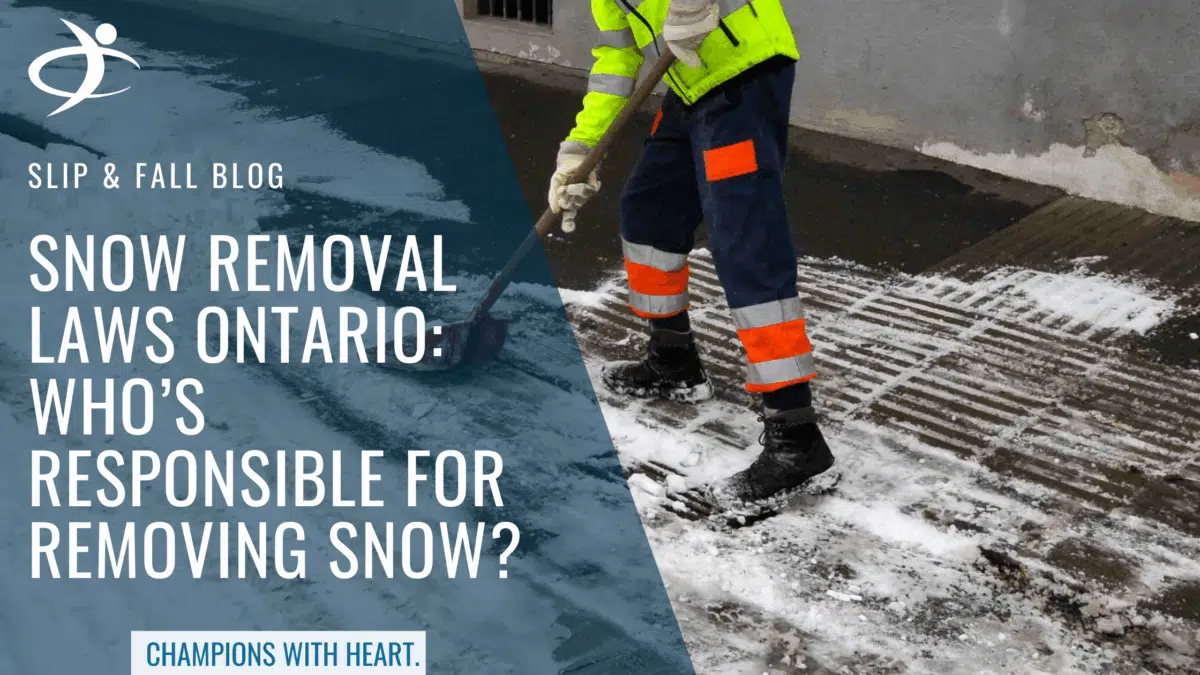
Winter in Ontario means more than beautiful snowfall; it brings obligations. Under Ontario’s laws and municipal bylaws, snow and ice removal is both a good practice and often a legal requirement. This article explores snow removal laws in Ontario, clarifies who must clear snow from sidewalks, driveways, and properties (homeowners, landlords or tenants), and explains why it matters for safety, liability and your peace of mind.

Legal Responsibilities for Homeowners Clearing Snow

Homeowners in Ontario, whether living in a detached house, a townhouse, or small building, have responsibilities for snow and ice removal.

  • In many municipalities, local bylaws require property owners to clear adjacent sidewalks within a specified timeframe after snowfall.
  • Homeowners must also ensure driveways, stairs, walkways, and entrances remain free of hazardous accumulations of snow or ice. Failing to do so could create liability and make you responsible if someone slips and falls.
  • While laws vary by municipality, the guiding principle remains: property owners must take reasonable steps to keep their property (and adjacent sidewalks when required) clear and safe during winter.

If you own a home, ensure you remove snow in a timely manner. If you’re a homeowner in a municipality with a sidewalk clearing bylaw, don’t forget the sidewalk.

Who Is Responsible for Snow Removal at a Rental Property?

When a property is rented, whether it’s a single-family home, duplex, townhouse or multi-unit building, the picture can become more complex. Responsibilities can vary based on lease terms, property type, and local laws.
The primary law governing this in Ontario is the Residential Tenancies Act, 2006 (the “RTA”). Under this law, landlords are required to maintain the rental property in good repair and ensure it is fit for habitation. Specifically, Section 20(1) of the RTA states: 

“A landlord is responsible for providing and maintaining a residential complex, including the rental units in it, in a good state of repair and fit for habitation and for complying with health, safety, housing and maintenance standards:

That duty extends beyond the interior. It includes exterior walkways, driveways, entrances and other shared or common areas.

Because of this duty, even if a lease appears to assign snow shoveling to a tenant, such clauses may be unenforceable, at least with respect to common areas. Courts have found that the owner’s maintenance obligation under the RTA cannot be signed away in a standard lease.That said, there are situations where a tenant can have snow removal responsibilities, but only under specific conditions:

Is The Landlord Responsible for Snow Removal?

  • For multi-unit buildings (apartments, condos, duplexes, etc.), and for common areas (driveways, parking lots, shared walkways, building entrances, stairwells), the landlord remains responsible for snow and ice removal.
  • The landlord must clear snow and keep walkways safe. If they fail to do so and someone is injured, the landlord may be held liable.
  • If the lease tries to shift this burden onto tenants, the clause is often unenforceable. In many cases, courts will disregard it if it conflicts with the RTA’s maintenance obligations.

Are Tenants Responsible for Snow Removal?

Tenants may be responsible for snow removal only in limited, clearly defined circumstances:

  • If a tenant rents a single-family home or a unit with exclusive, private walkways, driveway, or backyard/patio, and the lease includes a separate, written agreement assigning snow removal (ideally framed as a contract for services), the tenant may lawfully take on snow removal duties.
  • The agreement must provide appropriate consideration (for example, a rent reduction or separate payment) in return for snow shoveling services.
  • Even when tenants agree to snow removal, landlords should periodically inspect to ensure the work is done properly. Failure to supervise might still lead to liability if hazards remain.
  • Snow or ice on balconies, patios, or designated parking spots (if those are covered by the tenant’s exclusive use) are examples of areas where a tenant might reasonably take responsibility.

In short, unless there is a proper separate agreement and the area is exclusively the tenant’s to control, responsibility generally remains with the landlord.  

Who Is Responsible for Clearing Snow from Sidewalks?

Sidewalks adjacent to properties add another layer of complexity. Responsibility often depends on municipal bylaws rather than just the RTA, and those bylaws vary across Ontario municipalities.

  • Many municipalities require property owners (homeowners or landlords) to clear any sidewalk directly in front of, alongside or behind their building within a set timeframe after snowfall.
  • Failure to comply can result in fines or the municipality stepping in and later billing the property owner.
  • If a property owner fails to clear their sidewalk or inadvertently creates additional hazards (for instance, improper drainage or ice from downspouts freezing onto the sidewalk), they may face liability if someone slips and falls.

For homeowners and landlords, compliance with municipal sidewalk bylaws is as important as complying with provincial standards under the RTA.

Case Law and Legal Precedents

The landmark case Montgomery v. Van (2009 ONCA 808) remains the most cited precedent on this issue. In that case:

  • The lease required the tenant to keep the walkway and stairs free of snow and ice.
  • The tenant slipped and was injured. The court held that, despite the lease clause, the landlord remained liable because the duty to maintain safe premises cannot be waived by a standard lease clause.
  • The court explained that for a tenant to lawfully assume snow removal duties, the agreement must be a separate contract for services, not just a clause in a standard tenancy agreement.

This precedent has shaped how landlords and tenants approach snow and ice removal in Ontario rentals, especially for shared or common areas.

Practical Steps for Homeowners, Landlords & Tenants to Minimize Risk

Whether you own your property or rent, and whether you are a homeowner, landlord or tenant, winter snow brings real risk. Here are practical steps to minimize liability, avoid fines, and keep everyone safe.

  1. Know the local bylaws. Municipal snow removal bylaws vary across Ontario. Check your local bylaws for sidewalk-clearing deadlines and whether responsibility lies with the property owner or the municipality.
  2. Review (or draft) your lease carefully. If you are a landlord and want to assign snow shoveling to a tenant, consider drafting a separate contract for services. Include clear terms: which areas, what services, when, and what compensation is offered.
  3. Maintain documentation. Record all snow removal efforts, including date, time, areas cleared, weather conditions, and photos. This can be vital evidence if someone slips, falls, or if a municipality complains.
  4. Communicate with tenants proactively. Whether you hire a snow removal company, assign duties to a tenant, or handle the work yourself, let tenants know the plan in advance of the snow season.
  5. Address icy hazards beyond just snow. Clearing snow may not be enough. Ice buildup, freezing rain, or downspouts that funnel water onto sidewalks can all lead to slippery surfaces.
  6. Consider professional snow removal services. For landlords or homeowners with multiple properties, or for those unable to shovel safely, hiring a snow removal service can reduce risk and ensure compliance.

Final Thoughts on Snow Removal Laws in Ontario

Winter in Ontario brings many joys: fresh snow, cozy evenings, and winter sports. But it also brings legal obligations. Snow removal laws in Ontario are not just a concern for lawyers. They affect homeowners, landlords, tenants, and municipalities alike.

The duty to clear snow and ice is grounded in both provincial law (through the RTA) and municipal bylaws (for sidewalk clearing). For rental properties, the default responsibility lies with the landlord, especially for common areas. While tenants can sometimes assume snow removal duties, this requires a separate, properly drafted agreement.

At Campisi LLP, we understand how dangerous slips and falls can be, especially for vulnerable individuals. We encourage all homeowners, landlords, and tenants to take snow and ice removal seriously. If you or a loved one has suffered an injury due to unsafe snow or ice conditions, whether at a rental property or private home, you may have grounds to seek legal advice and hold the responsible party accountable.

If you would like our help or want to understand your rights under the law, we are here for you.
What is the Occupiers’ Liability Act in Ontario?

Accidents happen, but when they occur on someone else’s property, the law in Ontario provides clear guidance on who may be held responsible. The Occupiers’ Liability Act is the legislation that outlines the duties of property owners, landlords, business operators, and others who are considered “occupiers” of premises. Understanding this Act is key for anyone injured on someone else’s property, whether it was a slip and fall on an icy sidewalk or a trip over a loose tile in a store. In this article, we explain what the Occupiers’ Liability Act is, who it applies to, and what your rights and responsibilities are under the law. 

What is the Occupiers’ Liability Act? 

The Occupiers’ Liability Act in Ontario is a provincial law that sets out the responsibilities of individuals and organizations that control or possess property. Its core purpose is to ensure that anyone entering a property is kept reasonably safe while on the premises. 

Unlike traditional negligence laws, which are often based on common law principles, the Occupiers’ Liability Act codifies the legal duties in clear, accessible terms. It applies to all types of premises, including: 

  • Private homes 
  • Commercial buildings 
  • Rental units 
  • Public spaces such as parks or sidewalks 
  • Recreational lands 

Who is Considered an “Occupier”? 

An “occupier” is broadly defined under the Act. It refers not only to property owners but also to anyone who has physical possession of the premises or control over the condition of the property, its activities, or the persons allowed to enter. This can include: 

  • Homeowners 
  • Tenants 
  • Property managers 
  • Business operators 
  • Landlords (in certain cases) 

For example, if a store leases space in a mall, the store owner may be considered an occupier of the interior space, while the mall management may be the occupier of common areas such as hallways and entrances. 

What is the Duty of Care in Ontario? 

The Act imposes a duty of care on occupiers to take reasonable steps to ensure that people entering the premises are safe. Specifically, Section 3(1) states: 

“An occupier of premises owes a duty to take such care as in all the circumstances of the case is reasonable to see that persons entering on the premises… are reasonably safe while on the premises.” 

This duty applies to any lawful visitor, including customers, tenants, delivery workers, and even social guests. It includes maintaining safe conditions, performing timely repairs, warning of hazards, and preventing foreseeable injuries. 

Examples of Reasonable Care 

  • Shovelling and salting icy walkways during winter 
  • Fixing broken steps or railings 
  • Cleaning spills promptly 
  • Posting warning signs for wet floors or renovations 
  • Ensuring proper lighting in hallways and stairwells 

Failing to meet this duty of care could result in legal liability if someone is injured. 

Who Can Be Held Liable Under the Act? 

Multiple parties may be considered occupiers at the same time. Liability can extend to: 

  • Homeowners who do not maintain safe conditions on their property 
  • Landlords, depending on whether they retain control over common areas 
  • Tenants, if the rental agreement gives them control over specific areas 
  • Business owners are responsible for the safety of customers and staff 
  • Condominium corporations, for shared spaces like lobbies or parking garages 

For instance, in a rental apartment building, the landlord may be responsible for maintaining staircases and entryways, while a tenant may be responsible for snow removal from a private walkway if explicitly agreed upon in a separate contract. 

This ties directly into snow removal laws in Ontario, which often intersect with occupiers’ liability. If snow or ice is not cleared and someone is injured, the person responsible for maintenance, under the Act or a lease agreement, could be held liable. 

Common Situations Covered by the Act 

Slip and Fall Accidents 

Slip and falls are among the most common types of claims under the Occupiers’ Liability Act. These can result from: 

  • Icy or snowy walkways 
  • Wet or slippery floors 
  • Loose carpeting or mats 
  • Poor lighting 
  • Cluttered pathways 

If you’ve experienced a fall, our steps below on what to do after a slip and fall can help you take the right steps. 

Injuries on Private or Commercial Property 

Whether you’re visiting a friend or shopping at a retail store, you expect the premises to be safe. Common hazards include: 

  • Broken stairs 
  • Missing handrails 
  • Unsafe balconies 
  • Objects falling from shelves 

Occupiers are expected to either remove hazards or post clear warnings. 

Recreational Properties 

The Act also applies to recreational properties, such as trails, skating rinks, or sports fields. However, there’s a distinction when it comes to recreational land made available for free public use. In such cases, the occupier owes a lower duty of care, similar to the duty owed to a trespasser: not to create danger or act with reckless disregard. 

Exceptions and Limitations Under the Act 

While the Occupiers’ Liability Act is broad in scope, there are key exceptions: 

Trespassers 

The duty of care does not extend in the same way to trespassers. That said, occupiers still have a duty not to deliberately create danger or act with reckless disregard for the safety of anyone on the premises, even if they are trespassing. 

Voluntary Assumption of Risk 

In some cases, an individual may knowingly accept the risks associated with entering a property. For example, someone who attends a hockey game at an outdoor rink might be seen as accepting some degree of risk. However, this does not mean the occupier is off the hook completely. 

Liability Waivers 

Many businesses use liability waivers to limit responsibility, especially in gyms, trampoline parks, or ski resorts. While these waivers can offer some protection, they are not foolproof and do not override gross negligence or failure to meet a basic duty of care. 

What Should You Do If You Have Been Injured on Someone Else’s Property? 

If you’ve been hurt because a property was unsafe, the steps you take immediately afterward can make a significant difference in your ability to recover compensation: 

  1. Report the Incident: Notify the property owner or manager as soon as possible. 
  1. Document the Scene: Take photos of what caused your injury (e.g., icy sidewalk, broken tile). 
  1. Gather Contact Information: Get the names of witnesses and anyone else involved. 
  1. Seek Medical Attention: Even if your injury seems minor at first. 
  1. Keep Records: Save medical reports, prescriptions, and any communication with the property owner. 
  1. Consult a Lawyer: A lawyer can help you understand your rights under the Occupiers’ Liability Act and assess whether you may have a claim. 

How Campisi LLP Can Help 

At Campisi LLP, we represent individuals who have suffered serious injuries because someone failed to maintain a safe environment. We understand how devastating a preventable accident can be, and we are committed to helping our clients recover physically, emotionally and financially. 

We handle all types of premises liability claims, including: 

  • Slip and falls on ice or wet floors 
  • Injuries in apartment buildings or condos 
  • Falls due to poor lighting or broken stairs 
  • Accidents in public or recreational spaces 

Our legal team will investigate the circumstances, gather evidence, and work with medical professionals to understand the full impact of your injury. We are committed to providing clear guidance, compassionate care, and strong legal support throughout your case. 

Final Thoughts on the Occupiers’ Liability Act in Ontario 

The Occupiers’ Liability Act in Ontario plays a vital role in protecting the public. Whether you’re entering a store, renting an apartment, or walking on a sidewalk, the law expects the person or organization in control of that space to take reasonable steps to keep it safe. 

If they fail to meet that standard and someone is injured as a result, the law provides a path to accountability. That path can be complicated, especially when multiple parties are involved or when maintenance responsibilities are unclear. But with the right legal support, injury victims can seek justice and secure the compensation they need to move forward. 

If you or someone you love has been injured on someone else’s property, Campisi LLP is here to help. We will review your situation, explain your options, and guide you every step of the way.