Champions With Heart.

An Overview On Threshold And Its Importance

One of the trade-offs the insurance industry negotiated before it accepted the “no-fault” accident benefits scheme was a limitation on accident victims’ right to sue for pain and suffering and health care damages.  In order to succeed as a plaintiff, you must prove on the balance of probabilities (“more likely than not”) that you have suffered a permanent, serious impairment of an important physical, mental or psychological function.  Less often, you can demonstrate a permanent serious disfigurement.  This limitation is known as the “threshold” and is used routinely by insurance defence lawyers to pressure plaintiffs, and particularly those of you suffering from chronic pain conditions or mild traumatic brain injuries, into settling for less than your cases are worth.   They will claim that there is no objective evidence that you meet the threshold. As a result, a judge will not allow any award for pain and suffering or health care at trial. And, they will claim, you will end up with nothing or even owing the defendant money for legal costs.

Read More about An Overview On Threshold And Its Importance

Accident Benefits Update- LAT Considers CAT Based On Glasgow Coma Scale

A designation of catastrophic impairment (CAT) following a car accident provides an injury victim with access to greatly enhanced medical, rehabilitative and other benefits under the Statutory Accident Benefits Schedule (SABS).  There are several categories of impairment that qualify immediately as catastrophic, including a Glasgow Coma Scale (GCS) score of 9 or lower.

Read More about Accident Benefits Update- LAT Considers CAT Based On Glasgow Coma Scale

Accident Benefits Update: LAT Examines Glasgow Coma Scale As Category

In a recent decision of the Licence Appeal Tribunal, E.W. v Primmum Insurance Company, the applicant, E.W. had been seriously injured in a single vehicle collision while under the influence of alcohol.  He suffered extensive orthopedic injuries requiring ongoing rehabilitation to the point that he exhausted his monetary limits under the Statutory Accident Benefits Schedule (SABS).  As a result, he applied for a determination of Catastrophic Impairment (CAT), which if accepted, would provide greatly enhanced medical benefits.
Immediate grounds for a CAT determination exist where an insured suffers a brain impairment that results in a score of 9 or less on a test of cognition known as the Glasgow Coma Scale (GCS) within a reasonable time after the accident. E.W. based his CAT application entirely upon a GCS of 8T recorded immediately following his surgery.

Read More about Accident Benefits Update: LAT Examines Glasgow Coma Scale As Category

Accident Benefits Updates- Striving to Establish Your Best New “Normal”

When you (or someone you love) has been seriously injured in a car accident, the impact on your life is devastating. It can be difficult pushing ahead with rehabilitation, striving to establish your best new “normal” in the face of physical, psychological or cognitive obstacles which seem overwhelming.

Read More about Accident Benefits Updates- Striving to Establish Your Best New “Normal”

Manage Your Accident & Sports Related Injuries

Concussions are in the news a lot in sports-related injuries- especially hockey and football as high-profile athletes suffer repeated head injuries that can shorten their careers and permanently impact their lives. As a result, more attention and money has been devoted recently to understanding the diagnosis and treatment and long-term effects of concussions.

Read More about Manage Your Accident & Sports Related Injuries

Old Personal Injury Case

Accident victims who suffer catastrophic impairments can access greatly enhanced accident benefits funding, which in turn promotes higher value claims settlements. To be deemed catastrophically impaired under the criteria set out in the Statutory Accident Benefits Schedule (SABS), an accident victim with a Traumatic Brain Injury (TBI) requires objective evidence of the injury on diagnostic imaging, supported by expert medical opinions. This presents a challenge when the initial trauma results in a mild TBI (or concussion), because these injuries do not usually show up on standard imaging technology (x-ray, CT and MRI). Recently, however, scans taken with a newer technology called single-photon emission computerized tomography (SPECT) have been accepted by Ontario courts as an evidentiary tool for demonstrating mild TBI, although its use has been controversial.

Read More about Old Personal Injury Case

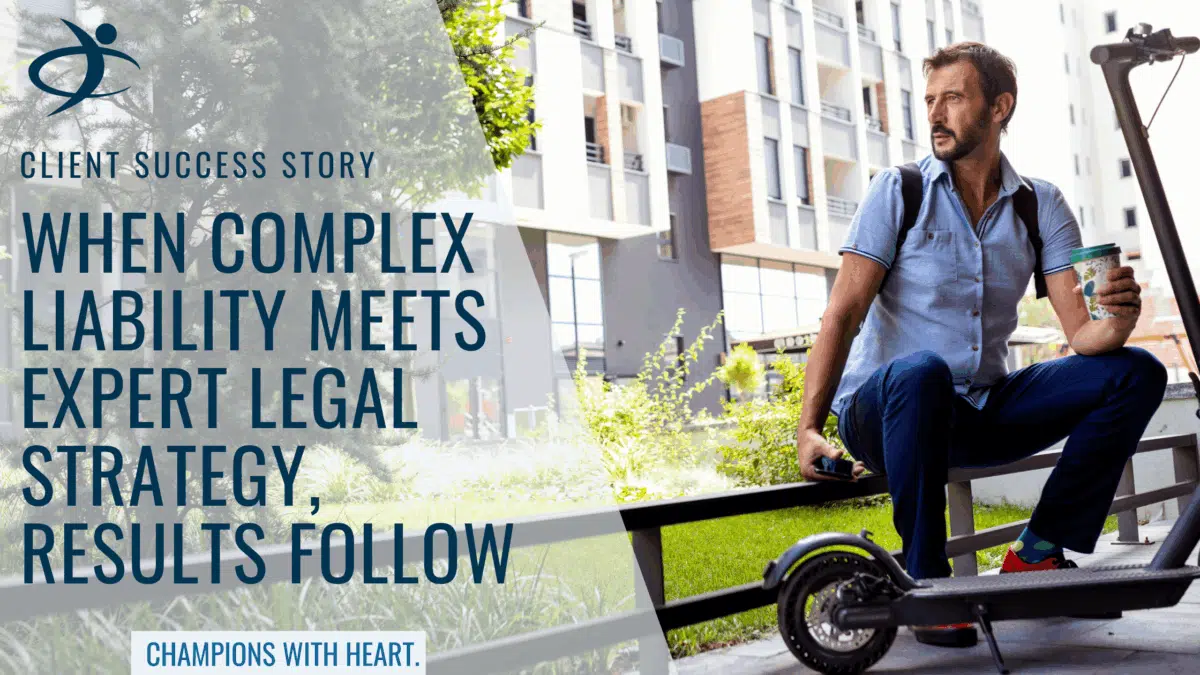
When Complex Liability Meets Expert Legal Strategy, Results Follow

David’s case seemed impossible from the start. Uninsured scooter. Running a red light. Never checking for oncoming traffic. The case’s prospects looked bleak, if they existed at all.

David faced what appeared to be an unwinnable situation after a serious electric scooter collision. But Campisi Law saw beyond the challenges and secured a $1.1 million recovery, proving that even the most complex liability scenarios can yield substantial results.

Read More about When Complex Liability Meets Expert Legal Strategy, Results Follow