Champions With Heart.

Is an employer responsible if an employee contracts COVID-19?
The second wave of COVID-19 infections threatens to undermine the significant progress we have made in establishing a balance that takes account of the need to jump-start the economy and the legitimate safety concerns of workers returning to their jobs. The government and regulatory bodies in Ontario and Canada have established protocols and standards aimed at reducing the risk of spreading the virus. 

It is up to each employer to ensure that appropriate measures are implemented and maintained. There are no systems in place to ensure compliance, but the Ministry has taken measures to increase inspections and has added 60 officials to support employers and employees in the field.

Employees are justifiably concerned that adequate measures are put in place at their workplace, and that their health and safety, and that of their families, are being protected. Often, these employees simply must trust that their employers are holding up their end of the bargain. Employees have the right to file a complaint with the Ministry of Labour, but often the fear of retribution becomes an issue.

In Ontario, there is a general legal duty of care on employers to provide a safe workplace for workers and third parties. This general duty applies to the current COVID-19 crisis. If the duty is not met (for example, an employer refuses to ensure that physical distancing is maintained), an employee might be able to start a lawsuit seeking damages.

However, in practice, many injured workers cannot exercise this right. The Workplace Safety and Insurance Act (WSIA), which governs Workplace Safety and Insurance Board (WSIB) claims, establishes a “no-fault” system that provides benefits to eligible employees who have suffered a workplace injury in exchange for removing the employee’s right to sue. 

Click here to read six steps an employee who has contracted COVID-19 can take when considering whether to start a lawsuit against their employer.

New emergency fund opens to agricultural employers

Employers in the agricultural sector in certain provinces and territories can now apply for the Emergency On-Farm Support Fund, which provides a $35-million investment to improve health and safety on farms and in employee living quarters to prevent the spread of COVID-19.

“We understand the unique circumstances and challenges being felt on farms and are working hard to ensure the right supports are available. The health and safety of all workers, including temporary foreign workers in the agriculture industry who help protect Canada’s food security, continues to be a top priority,” says Carla Qualtrough, minister of employment, workforce development and disability inclusion.

In an interview with Canadian HR Reporter, Ashu Ismail, personal injury lawyer at Campisi Personal Injury Lawyers in Toronto, noted that employers may be liable if their workers contract COVID-19 in the workplace.

Read More about New emergency fund opens to agricultural employers

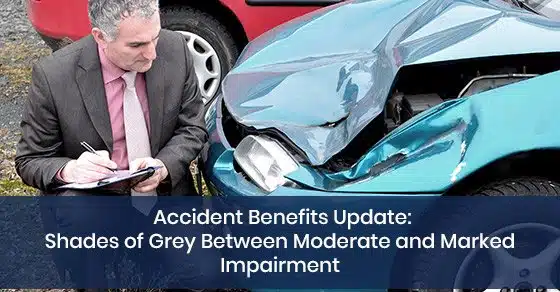
Accident Benefits Update: Shades of Grey between Moderate and Marked Impairment

K.S. andTD Home and Auto Insurance Company (2019 CanLII 22189), a recent decision by the Licence Appeal Tribunal (LAT), considered the fine line for establishing catastrophic impairment (catastrophic) under s.3(2)(f) of the Statutory Accident Benefits Schedule or SABS (prior to June 2016), which deals with Mental and Behavioural Disorders (MBD). The applicant, K.S., was injured on October 28, 2014 while riding his bicycle. He was struck by a passing motorcyclist and flung from his bike, landing on the pavement and splitting his head open. As a result of the accident, K.S. sustained physical injuries to his head, upper body, knees and a fractured neck. He also suffered psychological impairments including poor concentration, irritability, anxiety, stress and depression, as well as uncontrollable and sometimes violent outbursts.

Read More about Accident Benefits Update: Shades of Grey between Moderate and Marked Impairment

Despite COVID-19 guidelines, insurers still deny attendant care claims | Joseph Campisi

On June 3, more than two months after Ontario declared a state of emergency, the Financial Services Regulatory Authority of Ontario (FSRA) released an Interpretation titled: “Statutory Accident Benefits Claims during the COVID-19 Outbreak.” Its declared purpose is “to provide FSRA’s Interpretation of the requirements of subsections 1(9), 3(2)5 and 6(1) of O. Reg. 7/00 — Unfair or Deceptive Acts or Practices under the Insurance Act” in the context of statutory accident benefits (SABs) claims during the COVID-19 crisis.

These subsections set out the following as unfair or deceptive acts or practices:

Read More about Despite COVID-19 guidelines, insurers still deny attendant care claims | Joseph Campisi

Joseph Campisi: Ontario should eliminate civil jury trials

Ontario should follow Quebec’s lead and abolish civil jury trials. A jury trial in a civil case is not a constitutional right, as it is in criminal cases. Even before the COVID-19 pandemic, civil jury trials added to unnecessary delay and expense in the civil justice system. But now, with tax revenues collapsing, provincial budget deficits soaring and our courts in an unprecedented lockdown as a result of the pandemic, there is much greater urgency in addressing the defects of our civil justice system. The abolition of civil jury trials is a simple solution that would save both time and cost in our court system.

Read More about Joseph Campisi: Ontario should eliminate civil jury trials

COVID-19 Federal and Insurance Assistance for Businesses

As the COVID-19 crisis continues with no end in sight, many of you will face economic hardship and other obstacles that interfere with your ability to run your business. We have prepared this compilation of many the most impactful government relief measures that may be available for you in this time of uncertainty. It is based on our best current information and hopefully will answer some of your questions and offer guidance for further investigation into the benefits available. We will continue to monitor the news for updated information and will try to communicate any important updates promptly. We recommend that you confirm the current status of the measures we describe and review the websites for any other potential sources of assistance the government agencies might offer. As always, we hope that you and your loved ones are safe and are here for you if you have questions or concerns.

Read More about COVID-19 Federal and Insurance Assistance for Businesses

Accident Benefits Update: LAT split on “Reasonable and Necessary” CAT assessments

In V.L. vs. Pafco Insurance Company (2019 CanLII 119760), a recent hearing in writing before the Ontario Licence Appeal Tribunal (LAT), the applicant, V.L sought payment from Pafco, her insurer for the costs of her assessments to determine catastrophic impairment (catastrophic). Pafco had approved approximately 2/3 of the requested $25,719.25, denying the remaining $8,884.00 on the grounds that these costs were not reasonable or necessary. Two denied Chiropractic treatment plans were also in dispute.

Read More about Accident Benefits Update: LAT split on “Reasonable and Necessary” CAT assessments