Champions With Heart.

Representing Yourself in a No-Fault Insurance Claim? You Need to Know This.

If you or a loved one is injured in an automobile accident, life can get turned upside down in a heartbeat. All you want is to receive the treatment and support you need to return to normal life and put the incident behind you. It can be tempting to try to simplify the process of recovery by dealing with everything yourself instead of hiring legal professionals to handle your case. This option can be the quickest and can seem like the most efficient approach.

Read More about Representing Yourself in a No-Fault Insurance Claim? You Need to Know This.

DUI: Stats, Ontario Law, and Impacts of Charges

Impaired driving, also called driving under the influence or DUI, refers to the operation of a vehicle while the driver’s ability to do so is compromised by alcohol, prescription or non-prescription drugs, alone or in any combination. Types of vehicles where DUI charges could apply include not only road-going vehicles, but also off-road vehicles and ATVs, motorcycles, boats, and snowmobiles. While as a society we are doing a better job of exercising appropriate judgement when it comes to driving under the influence, DUIs remain the second leading criminal cause of death in Canada after homicide and the second most common criminal offence processed in Canadian courts.

Read More about DUI: Stats, Ontario Law, and Impacts of Charges

Campisi’s Nathan Tischler Quoted in Canadian Underwriter Magazine

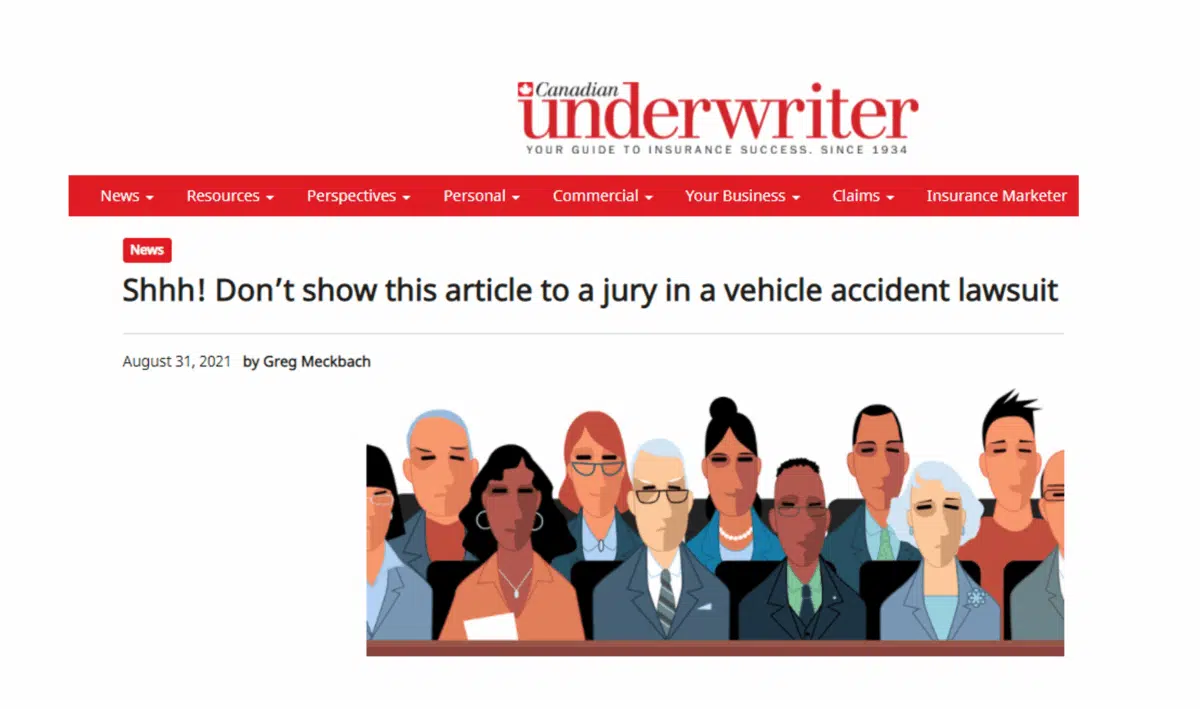
In the August 31st, 2021 article, “Shhh! Don’t show this article to a jury in a vehicle accident lawsuit“, insurance industry magazine Canadian Underwriter cites the expert opinion of Campisi lawyer Nathan Tischler in a story about motor vehicle accident tort claims. In the context of a recent lawsuit, writer Greg Meckbach highlights this fact to which jury members are often oblivious: that a statutory deductible of almost $40,000 exists for pain and suffering in these cases. 

Read More about Campisi’s Nathan Tischler Quoted in Canadian Underwriter Magazine

ACCIDENT BENEFITS UPDATE: AVIVA BEATS DEAD HORSE… TWICE!

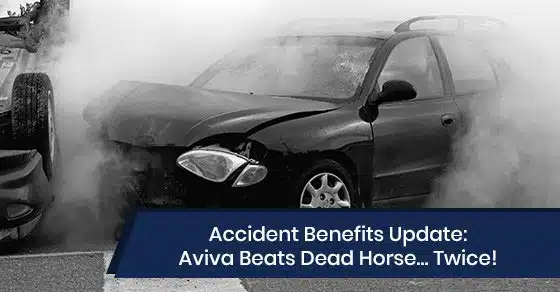
In two recent decisions of the Licence Appeal Tribunal, released on consecutive days, Aviva mounted spirited attempts to broaden the scope of accident benefits claims under the Minor Injury Guideline or MIG. N.R. and Aviva, 2019 CanLII 51313, and the Reconsideration Decision in G.S. and Aviva, 2019 CanLII 51320, were both heard in writing before Vice-Chair Susan Mather released May 9 and 10, respectively. At issue in both was whether the claimant’s chronic pain was a minor injury under the MIG. Historically, Aviva had some success in demonstrating that the presence of chronic pain does not remove a claimant from the MIG unless there is evidence of functional impairment.

Read More about ACCIDENT BENEFITS UPDATE: AVIVA BEATS DEAD HORSE… TWICE!

Accident Benefits Update: Proving Chronic Pain? – a Cautionary Tale

In S.K. v. Aviva Insurance Canada (2019 CanLII 126203) recent Reconsideration Hearing before the Licence Appeal Tribunal (LAT), the applicant S.K. argued that the LAT had erred in fact and at law by finding that her injuries were appropriately treated under the Minor Injury Guideline (MIG). As a result of this finding, her claims for outstanding treatment plans were also dismissed.

Read More about Accident Benefits Update: Proving Chronic Pain? – a Cautionary Tale

Accident Benefits Update: Shades of Grey between Moderate and Marked Impairment

K.S. andTD Home and Auto Insurance Company (2019 CanLII 22189), a recent decision by the Licence Appeal Tribunal (LAT), considered the fine line for establishing catastrophic impairment (catastrophic) under s.3(2)(f) of the Statutory Accident Benefits Schedule or SABS (prior to June 2016), which deals with Mental and Behavioural Disorders (MBD). The applicant, K.S., was injured on October 28, 2014 while riding his bicycle. He was struck by a passing motorcyclist and flung from his bike, landing on the pavement and splitting his head open. As a result of the accident, K.S. sustained physical injuries to his head, upper body, knees and a fractured neck. He also suffered psychological impairments including poor concentration, irritability, anxiety, stress and depression, as well as uncontrollable and sometimes violent outbursts.

Read More about Accident Benefits Update: Shades of Grey between Moderate and Marked Impairment
Accident Benefits Update: ONCA’s TOMEC Decision on SABS Limitations

On November 8, 2019, the Ontario Court of Appeal released Tomec v Economical Mutual Insurance Company (2019 ONCA 882). The central issue on the appeal was whether the two-year limitation to start a proceeding following a denial of accident benefits was a “hard” limitation or was subject to the principle of discoverability.

Read More about Accident Benefits Update: ONCA’s TOMEC Decision on SABS Limitations

The advantages of having an Accident Lawyer handle your accident benefit claim

In Ontario, it is possible for any injured person to file an accident benefits claim without legal representation. It’s known as self-representation.  But just because you can represent yourself, it doesn’t mean you should.

Notwithstanding the difficulty of managing your own claim while trying to recover from a injury, there are many nuances to conducting a claim that are not known to the average person.

Read More about The advantages of having an Accident Lawyer handle your accident benefit claim