Champions With Heart.

ACCIDENT BENEFITS UPDATE: FSCO MISSES THE POINT OF MIG APPEAL

In Aviva Canada Inc. v. Sleep(FSCO Appeal P17-00034), Director’s Delegate Murray was required to review an arbitration decision concerning the Minor Injury Guideline (MIG) of the Statutory Accident Benefits Schedule (SABS).  In the decision, Arbitrator Anschell found that the Respondent, Mr. Sleep had sustained injuries from a March 26, 2014 collision that exceeded the definition of “Minor Injury” under the MIG.

Read More about ACCIDENT BENEFITS UPDATE: FSCO MISSES THE POINT OF MIG APPEAL

An Overview On Threshold And Its Importance

One of the trade-offs the insurance industry negotiated before it accepted the “no-fault” accident benefits scheme was a limitation on accident victims’ right to sue for pain and suffering and health care damages.  In order to succeed as a plaintiff, you must prove on the balance of probabilities (“more likely than not”) that you have suffered a permanent, serious impairment of an important physical, mental or psychological function.  Less often, you can demonstrate a permanent serious disfigurement.  This limitation is known as the “threshold” and is used routinely by insurance defence lawyers to pressure plaintiffs, and particularly those of you suffering from chronic pain conditions or mild traumatic brain injuries, into settling for less than your cases are worth.   They will claim that there is no objective evidence that you meet the threshold. As a result, a judge will not allow any award for pain and suffering or health care at trial. And, they will claim, you will end up with nothing or even owing the defendant money for legal costs.

Read More about An Overview On Threshold And Its Importance

Accident Benefits Updates- More Encouraging Signs from the LAT

As we have discussed at length in recent posts, initial concerns regarding the competence of the Licence Appeal Tribunal (LAT) may have been somewhat overstated. This is not to say that accident victims are uniformly receiving appropriate adjudication at the LAT, as many decisions have come under fire for “cookie-cutter” responses and other failures. However, as the recent Reconsideration of 16-002325 v Aviva Insurance Canadashows, when such failures do occur, there is hope that a correct result can still be achieved.

Read More about Accident Benefits Updates- More Encouraging Signs from the LAT

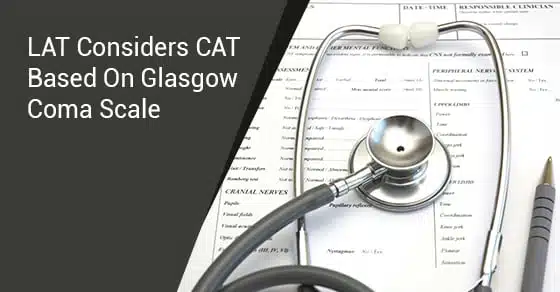
Accident Benefits Update- LAT Considers CAT Based On Glasgow Coma Scale

A designation of catastrophic impairment (CAT) following a car accident provides an injury victim with access to greatly enhanced medical, rehabilitative and other benefits under the Statutory Accident Benefits Schedule (SABS).  There are several categories of impairment that qualify immediately as catastrophic, including a Glasgow Coma Scale (GCS) score of 9 or lower.

Read More about Accident Benefits Update- LAT Considers CAT Based On Glasgow Coma Scale

Accident Benefits Update FSCO- Clarifies CAT Marked Impairment Threshold

In O’Brien v State Farm Mutual Automobile Insurance Company, a recent FSCO arbitration decision, the Applicant, Erik O’Brien was seriously injured in a car accident on August 21, 2008.  Despite extensive rehabilitation, he continued to suffer from Chronic Pain Syndrome with related depression and fatigue issue.  To support his family, he returned to work on modified duties 6 months after the accident, and full-time after that.  However, he was unable to continue working approximately 2 years after his return to work.

Read More about Accident Benefits Update FSCO- Clarifies CAT Marked Impairment Threshold

Accident Benefits Update: LAT Examines Glasgow Coma Scale As Category

In a recent decision of the Licence Appeal Tribunal, E.W. v Primmum Insurance Company, the applicant, E.W. had been seriously injured in a single vehicle collision while under the influence of alcohol.  He suffered extensive orthopedic injuries requiring ongoing rehabilitation to the point that he exhausted his monetary limits under the Statutory Accident Benefits Schedule (SABS).  As a result, he applied for a determination of Catastrophic Impairment (CAT), which if accepted, would provide greatly enhanced medical benefits.
Immediate grounds for a CAT determination exist where an insured suffers a brain impairment that results in a score of 9 or less on a test of cognition known as the Glasgow Coma Scale (GCS) within a reasonable time after the accident. E.W. based his CAT application entirely upon a GCS of 8T recorded immediately following his surgery.

Read More about Accident Benefits Update: LAT Examines Glasgow Coma Scale As Category

Mistake, Duress, Unconscionability: Can I Overturn A Bad Settlement?

Have you ever met someone who was in a car accident, settled his or her accident benefits claim or potential lawsuit but didn’t receive adequate compensation to cover ongoing medical treatment, lost time at work or personal or household assistance? Unfortunately, this happens far too frequently in Ontario- often, but not always, these accident victims are not represented by a lawyer, or by one who does not put their interest first.    

Read More about Mistake, Duress, Unconscionability: Can I Overturn A Bad Settlement?