Champions With Heart.

ACCIDENT BENEFITS UPDATE: INSURER CAN’T RELY ON PRIOR MIG REPORT

In Applicant v. Aviva Insurance Canada (2018 CanLII 110921), a recent Licence Appeal Tribunal (LAT) decision, the applicant was struck by another car while making a left hand turn on June 30, 2016.  Within two days of the accident, he reported back and left leg pain and began receiving physiotherapy. His employer provided accommodation for his injuries that allowed him to continue working.  He received accident benefits coverage from his insurer, Aviva subject to the $3500 cap under the Minor Injury Guideline (MIG). Subsequent treatment plans for physiotherapy, chiropractic and massage were denied and the applicant commenced a LAT proceeding to challenge the MIG designation and seek payment of the disputed plans.

Read More about ACCIDENT BENEFITS UPDATE: INSURER CAN’T RELY ON PRIOR MIG REPORT

Concussion: Not a “Minor” Injury!

Concussions (aka: mild Traumatic Brain injuries) are in the news a lot in sports-related injuries- especially hockey and football as high-profile athletes suffer repeated head injuries that can shorten their careers and permanently impact their lives. As a result, more attention and money has been devoted recently to understanding the diagnosis and treatment and long-term effects of concussions.

Read More about Concussion: Not a “Minor” Injury!

Campisi Success Story – Automobile Insurance Claim

On September 27, 2012, the Ontario Court of Appeal released its landmark decision in Pastore v Aviva.  Mrs. Pastore was successfully represented by Joseph Campisi, the founding partner of Campisi LLP.  It was a long and challenging fight over several years and multiple appeals. The stakes were very high for the insurance industry, and Aviva did not want to lose.  

Read More about Campisi Success Story – Automobile Insurance Claim

Lat Applies Heath Test- Orders Non-earner Benefits (Neb) For Chronic Pain

When you apply for accident benefits coverage after a car accident, you are required to elect one of: Income Replacement Benefits (IRB), Caregiver Benefits, or Non-Earner Benefits (NEB).  Of the three, NEBs have the most challenging criteria to meet. NEBs only kick in after six months AND have the highest threshold: the claimant must sustain an impairment as a result of an accident and suffer a complete inability to carry on a normal life as a result of and within 104 weeks after the accident and does not qualify for an income replacement benefit.

Read More about Lat Applies Heath Test- Orders Non-earner Benefits (Neb) For Chronic Pain

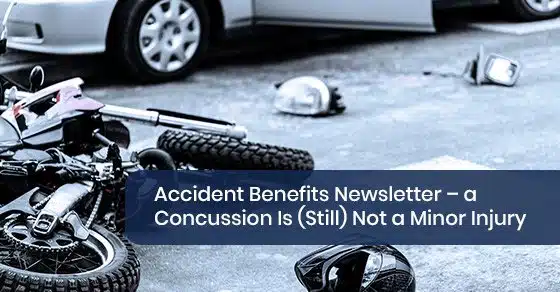
Accident Benefits Newsletter – a Concussion Is (Still) Not a Minor Injury

It is generally acknowledged that the Minor Injury Guideline (MIG) does not extend to traumatic brain Injuries (TBIs), regardless of the degree of initial severity. Any brain injury from mild to severe is equally outside the ambit of the MIG. It is also acknowledged that a concussion and Post-Concussion Syndrome (PCS) qualify as mild TBIs. Despite these acknowledgements however, Accident Benefits insurers continue to fight tooth and nail to keep concussion victims in the MIG.

Read More about Accident Benefits Newsletter – a Concussion Is (Still) Not a Minor Injury

ACCIDENT BENEFITS UPDATE- LAT CONSIDERS CAUSATION IN CAT CLAIM

In F.D. and Allstate Canada, a recent decision of the Licence Appeal Tribunal (LAT) before Adjudicator Daoud, causation was again a central issue in a claim for determination of catastrophic impairment (catastrophic). The claimant, F.D. had been rear-ended on August 6, 2014. She suffered extensive soft-tissue injuries, with post-concussion symptoms, anxiety and depression. She sought treatment for ongoing pain and functional limitations, as well as increasing cognitive dysfunction and psychological impairment. Her insurer, Allstate, paid her accident benefits claims up to the non-catastrophic limits then denied further funding. Mediation failed to resolve the issue between the parties, which led to the present hearing.
At the hearing, the sole issue was whether F.D. had suffered a catastrophic impairment from a Mental and Behavioral Disorder (MBD) as a result of the collision. A catastrophic determination would entitle her to enhanced benefits under the Statutory Accident Benefits Schedule (SABS).

Read More about ACCIDENT BENEFITS UPDATE- LAT CONSIDERS CAUSATION IN CAT CLAIM

Personal Injury Update: Second Psychiatric Assessment Granted 7 Months After Pre-Trial

This motion in Maria-Antony v. Ivaschenko, 2019 ONSC 4731 was brought by the defendants for leave to conduct a second psychiatric assessment of the plaintiff, Bridget Maria-Antony, who had been injured in two car accidents in 2009 and 2010. The moving defendants were involved in the second accident.

Read More about Personal Injury Update: Second Psychiatric Assessment Granted 7 Months After Pre-Trial

Accident Benefits Update- CAT Claim

In Pucci v. Wawanesa (2019 ONSC 1706), a recent Ontario Superior Court of Justice decision, the court weighed in on causation in a catastrophic impairment (catastrophic) claim. The plaintiff claimant, Brittany Pucci, had been injured in a car accident on June 16, 2013. She suffered various physical injuries and psychological impairments following the accident. Her insurer, Wawanesa paid for her accident benefits including income replacement benefits (IRBs), attendant care (AC) and housekeeping and home maintenance (HKHM) as required under the Statutory Accident Benefits Schedule (SABS) until her non-catastrophic limits were exhausted. Following termination, she applied to the Court for declarations that she had suffered a catastrophic impairment from a mental or behavioral disorder (MBD), and that she was entitled to ongoing IRBs, HKHM and AC benefits.

Read More about Accident Benefits Update- CAT Claim